You paid to attend a virtual conference. Four hundred people are in the same digital space as you. You can see the chat moving. Names appear and disappear. Someone makes a comment in the Q&A that is exactly the kind of thinking you have been looking for in your own work. You want to follow up.
You have no idea who they are.
You know their first name from the chat. That is all. You do not know what they do, where they work, whether they are a potential collaborator, a potential client or someone whose next three years of thinking will turn out to be closely parallel to yours. At a physical event, you would have walked over. You would have introduced yourself. The badge they wear tells you their name and company before you say a word.
At the virtual event, you type a reply into the chat and hope they see it among the thirty other messages that have appeared in the last ninety seconds.
This is the networking gap in virtual events. And it has been sitting there, mostly unaddressed, since virtual events became a serious format. Platforms solved content delivery. They built lobbies, auditoriums and breakout rooms. They added polls and leaderboards, and engagement scoring. But the fundamental question — who else is in this room, and how do I find the ones worth talking to — was left for attendees to solve themselves, usually via LinkedIn after the fact.
Why Attendees Have Been Invisible to Each Other
The reason is architectural, not accidental. Most event platforms are built around the registration record as the primary data entity. Name, email, ticket type, form responses. That is the attendee, as far as the platform is concerned. There is no layer between the registration and the event experience that allows an attendee to present themselves to other participants.
They exist in the system. They do not exist to each other.
The result is that, however well produced, virtual events consistently underdeliver on the thing that many attendees consider the primary reason to attend an event in the first place: the people. The content is recorded. The keynote is available on demand. The single thing that cannot be replicated after the fact is the conversation that happens when two people who should know each other are in the same room at the same time and find a way to connect.
Virtual events have the same opportunity as physical ones to create that moment. They have consistently failed to build the infrastructure for it.
What Changes When Attendees Have an Identity Within the Event
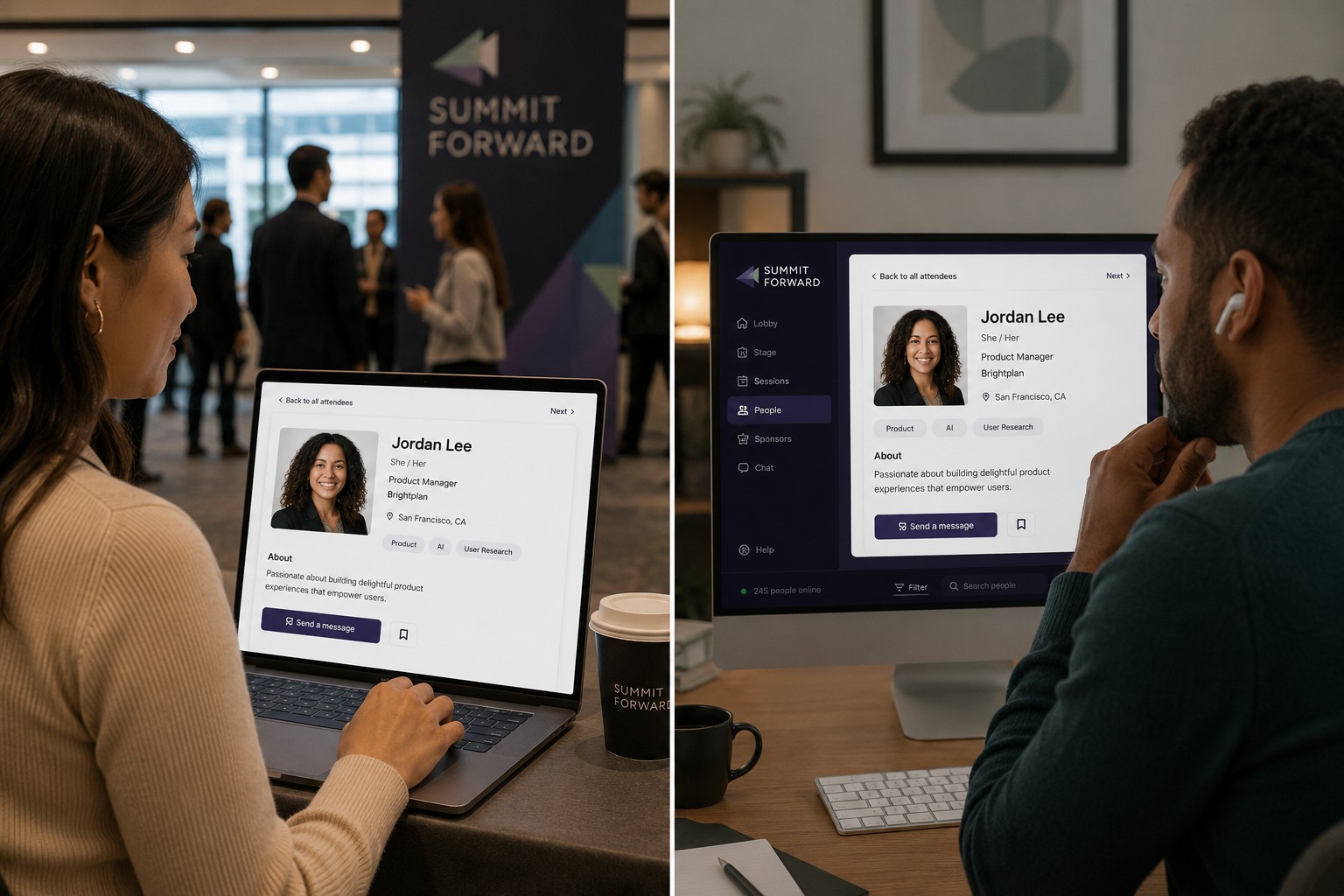
We shipped the Attendee Profiles and Directory feature in the Virtrio platform this month. The design principle behind it was straightforward: attendees should be able to present themselves to other participants on the platform and find and connect with the people most relevant to them, without leaving the event environment.
An attendee creates an opt-in profile — headline, company, a short bio, interest tags, links — and it becomes searchable within the event's Connect directory. Other attendees can find them, see what they do, see what topics they have tagged themselves with, and start a direct conversation or request a video call without switching tools or looking them up externally.
The interest tags are worth dwelling on, because they are the piece that changes the discovery dynamic most meaningfully. An organiser can define a set of tags relevant to their event — topic areas, industries, roles, whatever is most useful for their community. Attendees select the tags that apply to them. When you open someone's full profile, the tags you share with them are highlighted automatically.
You did not know this person existed an hour ago. Now you can see at a glance that you share three areas of interest. That is a different kind of introduction than a name in a chat box.
The directory sorts by name, by recent activity, or by engagement score — so if you want to find the most active participants in a session, you can. If you want to filter for people who have tagged themselves with a specific topic, you can do that too. Online presence is visible in real time, so you know who is actually there right now rather than who registered three weeks ago.
Privacy as a First Principle, Not an Afterthought
The feature is opt-in by design. An attendee who creates a profile controls their own visibility. They can make themselves visible in the directory or browse without appearing in it. That choice is theirs, and it can be changed at any time during the event.
This matters because the alternative — making attendees visible to each other by default — might seem to increase connection opportunity, but it erodes the trust that makes attendees willing to engage at all. People are more likely to create a genuine profile, with a real photo and a thoughtful bio, when they know they chose to be discoverable rather than being listed without being asked.
Organisers can configure directory availability per registration set. A VIP track might have the directory enabled, while a general admission track does not. A speaker cohort might be entirely excluded from the attendee directory. The configuration is flexible because different events have genuinely different needs, and a one-size approach to networking infrastructure tends to fit none of them well.
What This Means for the Event Experience
The practical effect of the Attendee Profiles and Directory is that virtual event networking stops being something that happens despite the platform and starts being something the platform actively supports.
An attendee who finds someone interesting in a session can open the Connect drawer, search for them, see their profile, and start a conversation — without leaving the event environment, without switching to LinkedIn, without hoping the chat notification reaches the right person. The conversation stays inside the platform. So does the context: engagement score, check-in status, the interest tags that explain why this person is worth talking to.
For professional communities in particular — where the networking is often as valuable as the content, sometimes more so — this changes what the platform can offer. An event is no longer just a broadcast with a chat box attached. It becomes an environment where members can find each other, quickly understand each other's context, and start conversations that might otherwise never happen because the infrastructure to initiate them was never there.
Organisers get visibility into how the directory is being used: profile adoption rates, the most common tags, and how many attendees have made themselves discoverable. That data is useful not just for reporting but for shaping future events — understanding what interests your community self-identifies with is insight that does not exist when attendees are just registration records.
The Gap We Were Filling
Before this feature shipped, every attendee on Virtrio existed to the platform as a data record and to other attendees as, at best, a name in a chat. That is the same position most virtual event platforms have left their attendees in for the last five years.
Content delivery at virtual events has been solved well enough. The networking problem has not been taken seriously as an infrastructure challenge. It has been treated as something attendees can figure out for themselves, with a LinkedIn search and a follow-up email after the event closes.
That is not good enough for events that ask attendees to pay to attend, ask members to renew, or ask sponsors to believe the audience they are reaching is genuinely engaged rather than passively logged in.
The people in the room are the reason most attendees show up. Building the infrastructure to help them find each other is not a nice-to-have. It is what makes the event worth being at.