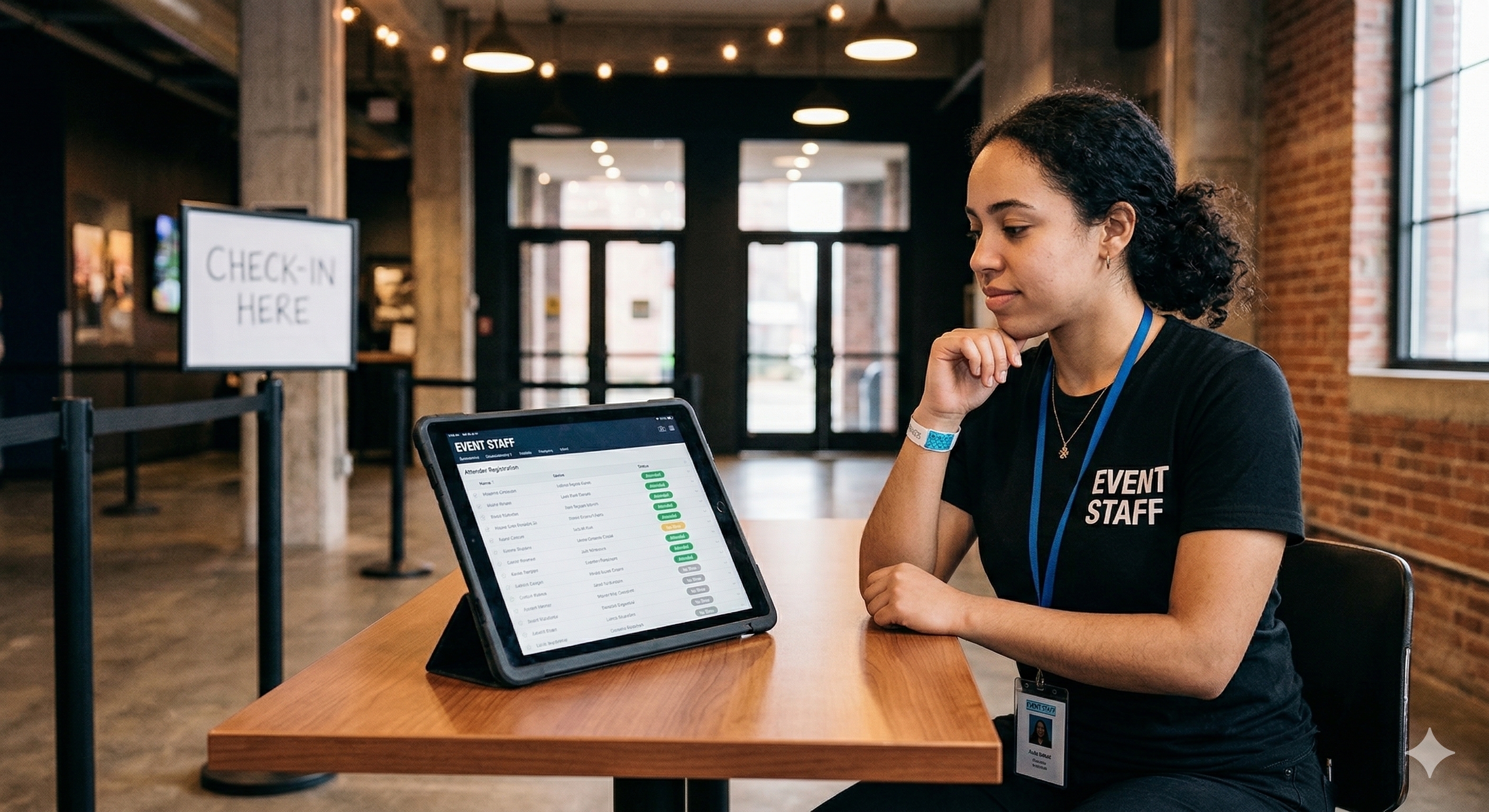
There are three moments in every event where an organiser reaches for a spreadsheet. Before the event, they need to track who hasn't confirmed their attendance. During the event, when they meet someone interesting, they scribble a note on a pad that will later get lost. And after the event, when they export registrations to a CSV and start colour-coding rows to manage outreach.
Three separate spreadsheets. Three separate moments where the rich data the platform has been collecting — engagement scores, session attendance, poll responses, check-in timestamps — remain on the platform while the organiser moves their work somewhere else entirely.
This is the problem with event attendee follow-up. And it's not a post-event problem. It runs across the entire lifecycle of an event. The spreadsheet is just the symptom. The root cause is that event platforms are built to collect data, not to help organisers act on it.
Before the Event: Chasing Confirmations in the Dark
Registration closed two weeks ago. You have 400 registrants. But experience tells you that paid or free, a meaningful percentage won't show up unless you follow up. Some registered impulsively and have since forgotten. Some have a question they haven't asked. Some need a nudge — the virtual access link re-sent, a logistics reminder, a personal note from the organiser that makes the event feel worth attending.
So you export the list. You add a Status column. You start working through it, marking each person as Contacted or No Response as you go. You try to remember, three days in, who you already called, who got an email and who is waiting on a callback.
Meanwhile, your co-organiser is doing the same thing on their own copy of the spreadsheet.
The attendees you both contacted will receive two calls within 48 hours of each other. The ones neither of you thought the other had handled will receive none.
This isn't a process failure. It's an infrastructure failure. There is no shared, real-time view of outreach status because it lives in a spreadsheet rather than being attached to the registration record itself.
During the Event: Notes That Never Make It Back
You're at the registration desk. A VIP attendee checks in and, in passing, mentions they'd be interested in sponsoring next year. You make a mental note. Later, during the networking session, you have three more conversations like it: a training provider interested in a custom deployment, a community manager asking about pricing, and a director who wants to introduce you to someone in their network.
Where do those notes go? On a pad. In your phone's notes app. In a text to yourself that you'll forget to action. In the best case, it goes into a spreadsheet you remember to update when you get back to the office.
The problem is not that you're forgetful. The problem is that there is nowhere obvious to put a contextual note against a registration record in the moment you're standing at the event. The platform that knows everything about that attendee — their engagement score, the sessions they attended, what they interacted with — is not the tool in your hand when you need to record what they just told you.
So the context disappears. Not immediately. It gradually disappears over the hours and days after the event as the specifics of each conversation fade and merge into a general impression.
After the Event: The CSV Graveyard
This is the phase most people mean when they talk about event attendee follow-up — and it has the same structural problem as the other two, just more visible.
You export the registration list. You sort by engagement score. You start by contacting your most engaged attendees while the event is still fresh. You log your outreach in a spreadsheet column. You move down the list.
What you cannot do with the CSV is pull up the full picture of who this person is in the context of your event. You can see their name, their email, their ticket type. You cannot see, without going back to the platform, that they attended four of five sessions, scored in the top 15% of the room, and interacted with two of your sponsors. That context, which would change the quality of every follow-up conversation, is sitting in a system you've left behind.
And once again, if two of you are working the list, coordination is a manual problem.
What It Looks Like When Follow-Up Stays in the Platform
The Attendee Action Tracker in vEvents is built around a simple architectural decision: follow-up activity belongs on the registration record, not in a separate tool.
The registration list gains an action status column — a colour-coded badge showing the current follow-up state for each registrant. Six statuses cover the most common workflow out of the box, with no configuration required:
- Not Contacted — the starting state for every registration.
- Contacted — outreach has been made.
- No Response — attempted, no reply received.
- Follow-Up Needed — flagged for a second pass
- Confirmed — the registrant has completed the desired action.
- Declined — the registrant has declined or is no longer engaged.
If your event workflow requires something specific — a status that maps to how your community or conference operates — you can add custom statuses scoped to that event. The platform defaults remain intact.
Working through a pre-event confirmation campaign: filter the registration list for 'Not Contacted,' work through it, log each interaction with a status and a note, and move on. Your co-organiser opens the same list and sees exactly where you got to. No sync call. No duplicated outreach. No gaps.
At the venue, after checking in an attendee, if they mention something worth following up, tap their entry, open the quick-action panel, and add a note. It's timestamped, attributed to you, and permanently attached to their registration. It doesn't live in your phone's notes app. It lives next to their engagement score and session history.
After the event, working through leads in order of engagement: every follow-up conversation has the full context. The note you added at the venue is right there. So is the engagement score, the check-in status, and the ticket type. You're not cross-referencing another screen. You're working from one place.
The Coordination Problem, Solved Structurally
In a multi-organiser event, the action tracker solves coordination by making the current state of every registration visible to the entire team simultaneously. There is no master copy of the spreadsheet. There is no version control problem. There is no 'I thought you'd handled that one.'
Every action entry records who created it and when. If Organiser A contacts someone and logs a note, Organiser B sees that before they pick up the phone. The audit trail is automatic, not a discipline requirement.
This matters more than it might seem. At scale — a 1500-person hybrid conference with two or three people managing follow-up — the coordination overhead of a spreadsheet-based system is significant. Reducing it to zero is not a minor convenience. It's the difference between a systematic outreach process and a best-effort one.
The Thread That Shouldn't Break
Every event generates a thread of knowledge about the people who attended — who engaged deeply, who were interested in what, who had a conversation worth continuing. That thread starts the moment someone registers and runs through the pre-event period, the event itself, and the weeks of follow-up.
Spreadsheets break that thread at every transition. The data stays in the platform. The follow-up moves out. The context that makes event attendee follow-up effective — the engagement data, the interaction history, the notes from the venue floor — never quite reaches where the work is happening.
Keeping follow-up inside the platform isn't about convenience. It's about making sure the thread doesn't break — before, during, and after the event.