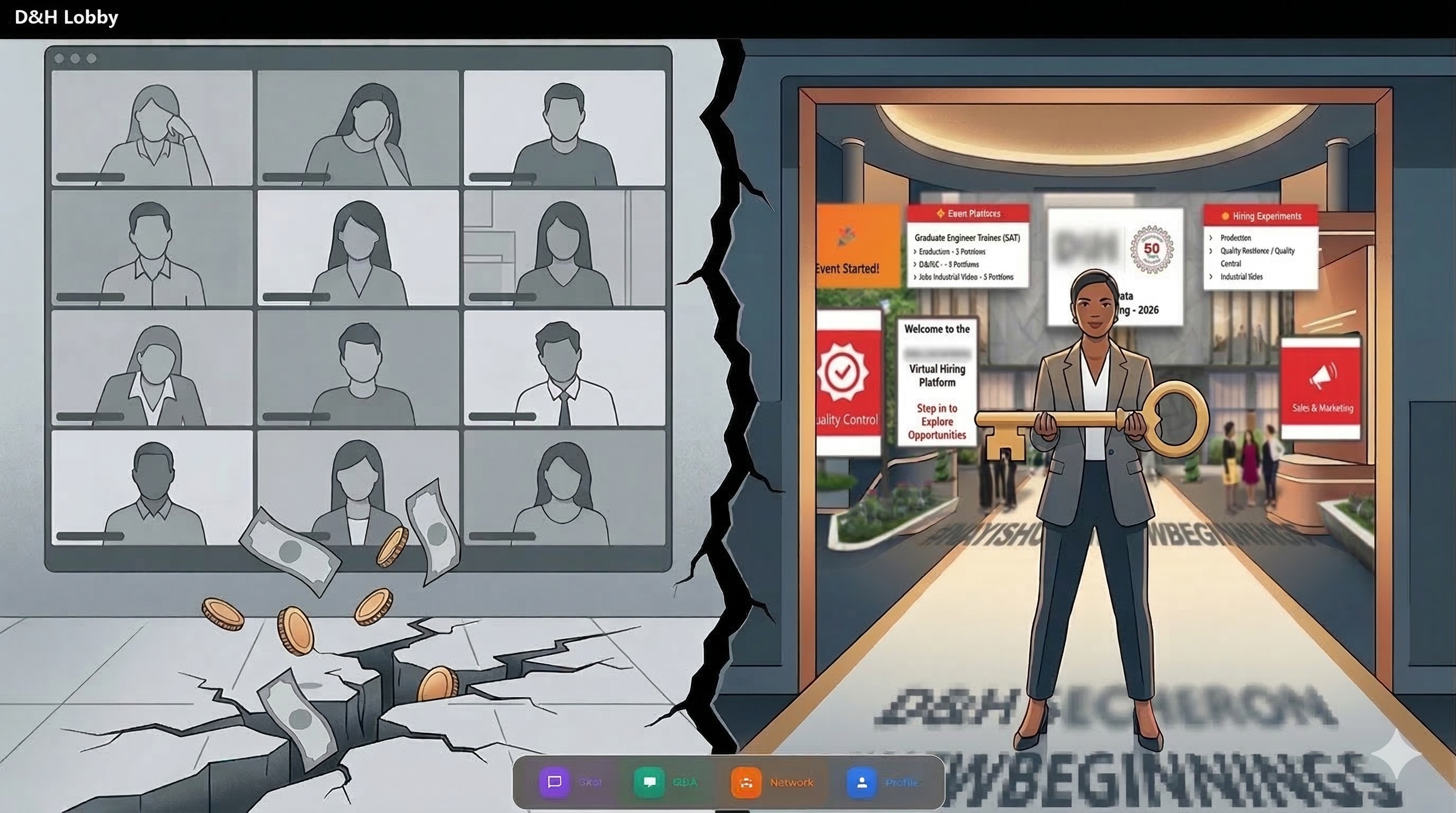
You secure a £40,000 production contract for a hybrid product launch. The stage design is strong, the run-of-show is well-planned, and the client is pleased with the creative direction. However, you must now justify a £5,000 charge for “virtual event delivery” after the client’s intern discovers the platform costs only £79 per month.
This scenario illustrates the margin trap, a challenge many boutique event production agencies have likely encountered.
The Pass-Through Problem
Typically, you license a standard video platform for a few hundred pounds annually. You add value through production expertise such as pre-event coordination, live directing, and attendee management, and charge a management fee. However, clients often compare your virtual delivery fee to the retail price of the software.
When your platform’s pricing is publicly available, your markup is exposed and subject to scrutiny. Clients may question the need for an agency when they believe they can manage the platform themselves for a monthly subscription fee.
As a result, event agency margins on virtual delivery are reduced to nearly zero. You are forced to bill for hours rather than value, which limits scalability and fails to reflect your production expertise.
The Deeper Problem: Platform Dilution
Margin compression is a financial symptom, while the underlying issue is brand dilution.
When you deliver a high-end client event on a commodity platform, the attendee experience is branded to that platform — not to your client, and certainly not to your agency. The login screen, the interface chrome, the email notifications — they all carry someone else’s identity. Your client’s brand gets relegated to a logo in the corner. For agencies focused on delivering bespoke experiences, this creates a strategic contradiction. You offer custom production but deliver it within a generic framework, which diminishes your value proposition.
A further consequence is reduced client retention. When the virtual component appears commoditised, clients may question the need for agency involvement and consider managing digital events internally.
The Arbitrage Model: Turning Infrastructure into Revenue
An increasing number of agencies are adopting an alternative approach that fundamentally changes the economics.
Instead of licensing a consumer-facing platform and reselling access to it, these agencies deploy a white-label virtual event platform as proprietary infrastructure. The platform carries no third-party branding. It runs on the agency’s domain (or the client’s domain). The registration emails, the attendee interface, the sponsor dashboards — everything renders as if the agency built it.
This approach shifts the commercial discussion. Instead of marking up a software licence that clients could purchase directly, you provide Digital Venue Infrastructure: a proprietary, secure, branded environment that clients cannot easily replicate.
The pricing model shifts from software pass-through to venue rental, a category where agencies have traditionally commanded premium fees. A white-label virtual venue applies this high-margin logic to digital delivery.
Here’s what the numbers can look like:
For example, with a fixed platform cost of £2,000 per month for unlimited client tenants, you can run 12 client events annually and charge each client £3,500 for the digital venue. This results in £42,000 in venue revenue against £24,000 in platform costs, generating £18,000 in additional margin that was previously lost.
This margin is in addition to production fees, content management, and analytics reporting you already provide.
What “White-Label” Actually Means in Practice
The term 'white-label' is often used loosely, so it is important to clarify what distinguishes genuine white-label infrastructure from platforms that only allow logo uploads.
Domain-level branding. Your client’s attendees register at agency.com/events/productname-launch, not at a third-party URL. The platform’s identity is completely invisible. To the end user, it looks like the agency (or the client) built a custom digital venue.
Multi-tenant data isolation. When managing clients from different industries, their data must be cryptographically separated with true tenant-level isolation and scoped access controls. This is essential when working with regulated industries, where data leakage is a compliance issue.
Full branding control. Colour systems, visual assets, welcome experiences, and email templates are all customisable per client and per event. This level of customisation supports venue-rental pricing rather than software-licensing fees.
Branded analytics. Sponsor reporting, attendee engagement scoring, and lead tracking are all delivered under your brand. Post-event performance reports should reinforce your agency’s value rather than promote another company’s software.
The Operational Reality for Multi-Client Agencies
Beyond economics, a key consideration is whether a boutique agency can efficiently manage multiple client environments without excessive administrative burden.
Platform architecture is critical. A solution designed for multi-tenancy with hierarchical permissions, scoped admin access, and centralised management enables you to operate a unified dashboard. You can quickly create branded environments for new clients, assign roles with granular permissions, and monitor all active events from a single interface.
In contrast, most agencies currently manage separate logins for each client, perform manual data exports for cross-event reporting, and frequently switch between platforms not designed for agency-scale operations.
Proof Points: What This Looks Like at Scale
This approach is already in practice. White-label virtual venue infrastructure supports large-scale events where brand control and data security are essential.
For example, a hybrid career event for women in STEM used this model to reach 3,200 virtual attendees and 300 in-person delegates, with 27 sponsor booths and parallel live streams. The organiser achieved 11 times the reach at half the cost of a physical event. Sponsors received detailed booth analytics, all branded to the event.
Another deployment for a financial services recruitment event managed 1,468 registrations and over 1,000 concurrent users, facilitating live video interviews, assessments, and on-demand content within a single branded environment over three days.
In both cases, the platform remained invisible, ensuring that the client’s brand was the only one visible to attendees.
The Strategic Question
For boutique event production agencies, the key question is not whether virtual and hybrid events are part of the future, but whether you will continue using platforms that reduce margins and dilute your brand, or invest in infrastructure that transforms digital delivery into a revenue centre.
Agencies that are advancing are not necessarily those with the largest teams or most impressive portfolios. Instead, they have developed proprietary digital venue capabilities using white-label infrastructure that clients perceive as custom-built.
The margin trap occurs only when the platform is visible. By making it invisible, you regain the economic benefits of venue ownership in a digital environment.