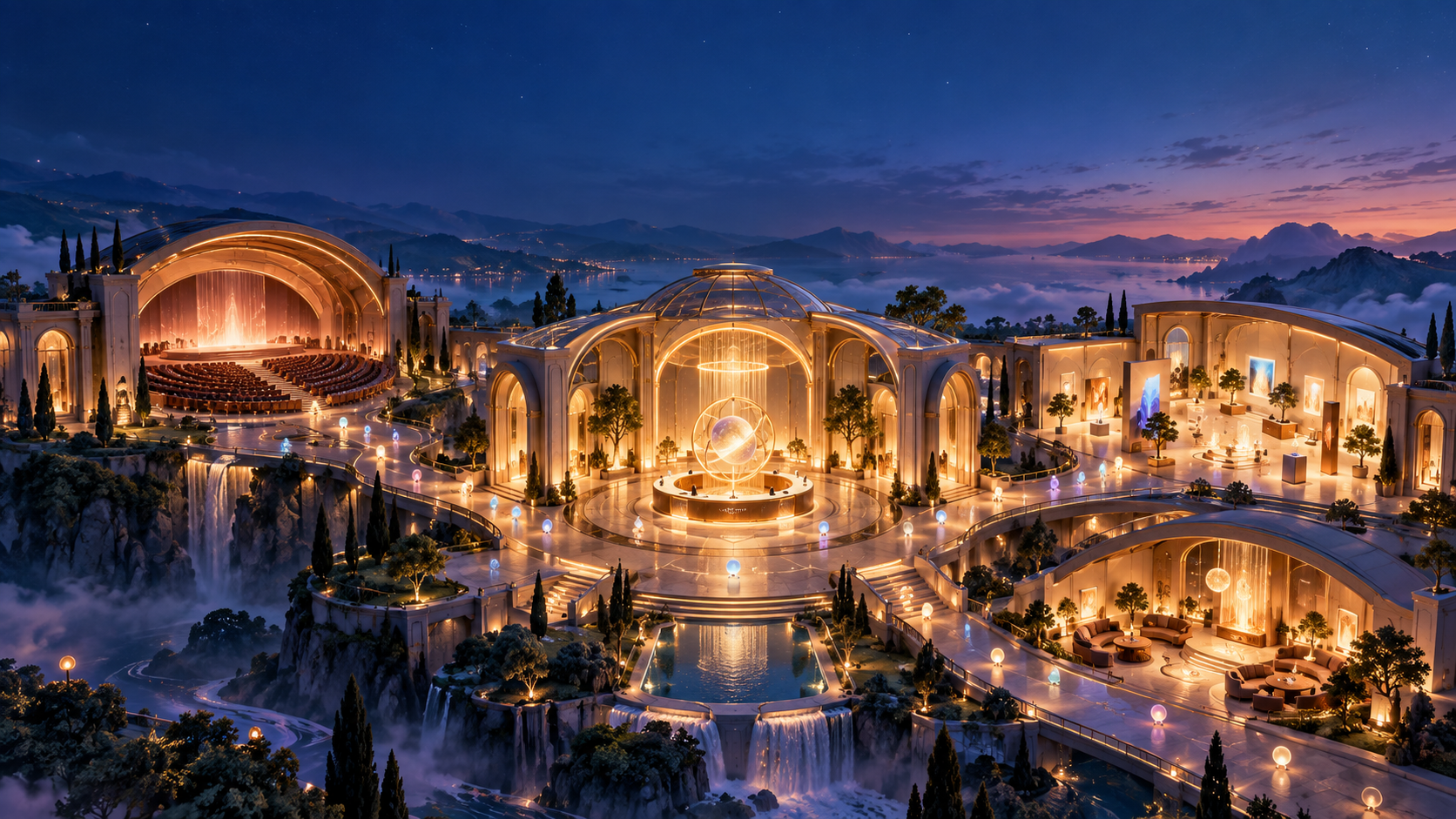
Does Venue Design Matter When the Venue Is Virtual?
Space changes behaviour, even on a screen. Consumer-neuroscience research by Nielsen found immersive environments elicit roughly 27% higher emotional engagement than flat-screen equivalents, and eye-tracking studies of virtual worlds show that world-focused, spatial interaction holds attention better than isolated object tasks. Most virtual event platforms ignore all of this and present the event as a list: a sidebar of sessions, a grid of links. A designed venue — a lobby that invites, rooms that connect, spaces that reward exploration — produces the wandering, dwelling and discovering that lists structurally cannot.
A virtual event venue is a designed spatial environment — lobby, rooms, booths, pathways — that attendees move through, rather than a menu of links they select from.
What does a list-based event actually cost you?
Predictability, in the worst sense. When the event interface is a schedule sidebar, attendee behaviour collapses to its minimum: join the session you registered for, leave when it ends. There is nowhere to wander, so nobody wanders. Nothing adjacent catches the eye, so sponsors get visited only by people who already intended to visit. The “event” is functionally a playlist — and playlists don’t generate serendipity, dwell time, or discovery.
That behaviour gap is invisible in attendance numbers and obvious in engagement numbers. The activities organisers most want — booth discovery, resource downloads, spontaneous networking, exploration between sessions — are precisely the behaviours a menu never prompts. Attendees can’t stumble across what the interface never puts in their path.
What does the research say about spatial environments?
That the effect is measurable and consistent: beyond the Nielsen finding on emotional engagement, academic work on virtual environments shows higher immersion improving both sense of presence and spatial memory — people remember places better than pages — and eye-tracking research from the Open University found that world-based interactions in 3D environments held participants’ attention more strongly than object- or avatar-level tasks. Research on participatory versus passive virtual experiences points the same way: agency inside a space, not just observing it, drives presence.
None of this requires headsets. The mechanism is spatial legibility — an environment the eye can read as a place, with regions, routes, and destinations — and it works in a browser as well as in a lobby made of marble.
How does a spatial venue work in practice?
As an architect, you compose rather than code. The model is a 2.5D canvas: each room is a designed backdrop — a lobby, an auditorium, a resource centre, an exhibition hall — with interactive elements positioned on it. A doorway is a navigation hotspot to another room. A wall screen plays video. A stand in the corner opens the exhibitor directory; a noticeboard is the live social wall; a corner table launches speed networking. The environment is the interface.
That’s the design system Virtrio is built around: organisers assemble rooms from a background and a catalogue of drag-and-drop widgets — video, polls, live Q&A, chat, quizzes, leaderboards, countdowns, directories — with no code involved, and link rooms into a venue attendees genuinely move through. Because every widget interaction is a tracked engagement event, the spatial design isn’t just prettier; it’s measurable. You can see which rooms drew traffic, which corners of the hall went cold, and redesign the next event’s architecture on evidence.
How should organisers think like venue designers?
Borrow the physical playbook. Give the venue a front door — a lobby that orients newcomers and signposts everything else. Create desire paths: put the sponsor hall between the lobby and the auditorium, not on a separate menu nobody opens. Reward exploration with things worth finding — a hidden quiz, a lounge, a leaderboard by the exit. And design for the in-between moments, because the fifteen minutes between sessions is where list-based events lose people to their inbox and spatial ones send them wandering into a booth.
The test of a virtual venue is the same as a physical one: would anyone enjoy arriving early?
FAQ
What is a 2.5D virtual event venue?A browser-based environment built from designed backdrops with interactive elements positioned in the scene — creating spatial depth and navigation between rooms without requiring 3D rendering or headsets.
Do immersive virtual environments actually improve engagement?Research consistently indicates yes: Nielsen’s consumer-neuroscience work measured around 27% higher emotional engagement for immersive formats, and studies link spatial environments to stronger presence, attention, and memory.
Can a spatial venue be built without developers?Yes — modern no-code room designers let organisers place backgrounds, widgets, and navigation hotspots visually, so venue design becomes an event-planning task rather than a software project.