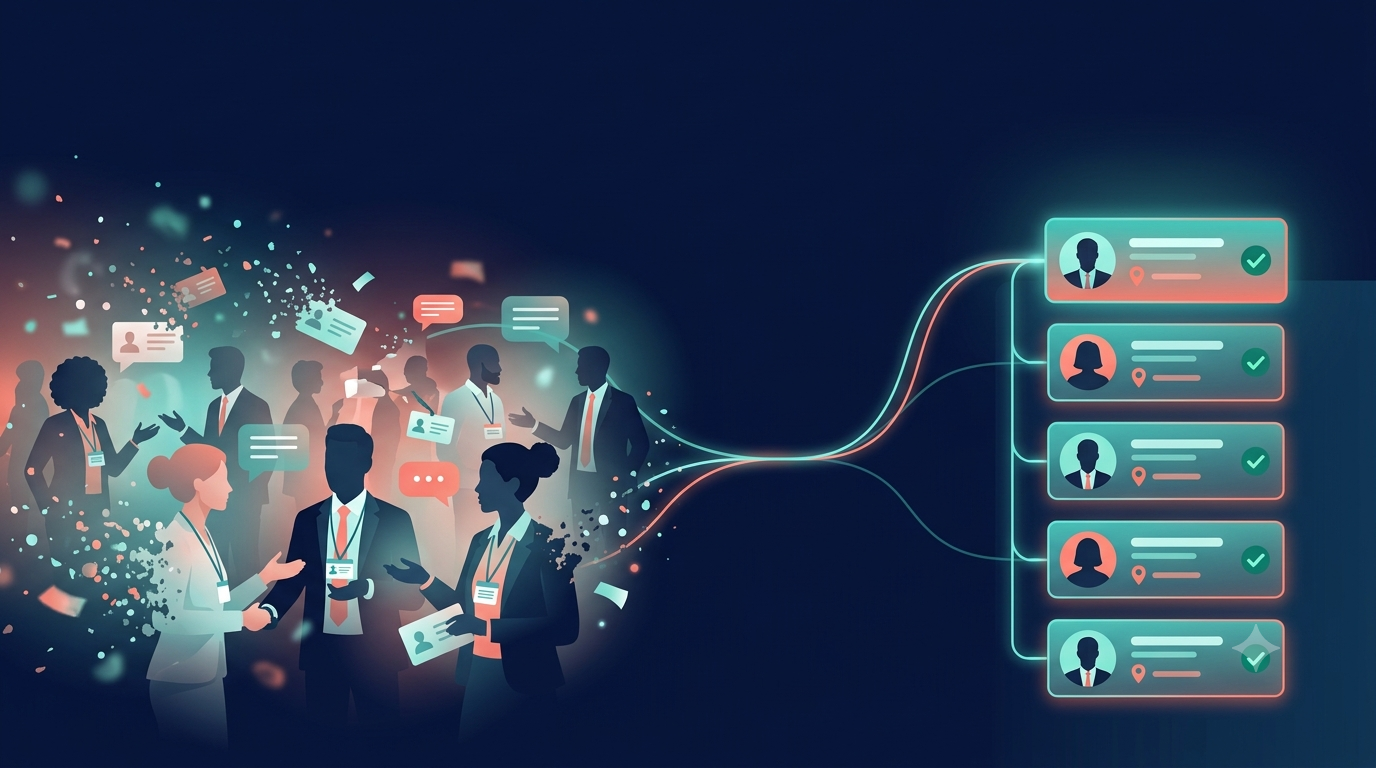
Event Networking Follow-Up: Why Most Event Connections Go Nowhere — and How to Fix It
You met fourteen people at the event. Two weeks later, you can name four of them. You remember one conversation clearly, vaguely recall a booth, and have a LinkedIn request pending from someone you cannot place. This is the quiet failure at the heart of event networking: the connections get made, and then they evaporate.
Industry research puts numbers on it. Around 80% of event leads never receive any follow-up at all, and fewer than half of exhibitors track leads beyond the event itself. Meanwhile, only about 2% of new business closes on first contact — which means the follow-up is the deal. Events are exceptionally good at starting conversations and exceptionally bad at helping anyone finish them.
Why does event networking fail after the event ends?
The short answer: intent is captured nowhere. During an event, attendees are in the moment — they meet someone interesting, agree to “connect after this”, and move to the next session. The intent to follow up is real, but it lives in memory, and memory decays within days.
The fallbacks people use don’t hold up either. Photographed badges sit in camera rolls. Business cards go into pockets and then drawers. LinkedIn requests arrive stripped of context — where did I meet this person, and what did we talk about? By the time an attendee sits down to do follow-up, the raw material is gone.
Event platforms have historically made this worse, not better. Most treat networking as a live-event feature: chat, meeting scheduling, matchmaking. The moment the event ends, the connections either vanish, get buried in an export nobody opens, or flow into a sponsor’s CRM — where the individual attendee gets nothing. Organisers get analytics; attendees get memories.
What is an attendee contact list?
An attendee contact list is a personal, persistent networking workspace built into the event platform itself. Every attendee gets their own private list of the people they chose to save during an event — with the context of where they met, plus statuses, notes, reminders, and the ability to export. It belongs to the attendee, not the organiser, and it survives long after the event ends.
That’s the feature we’ve just shipped, and the design decisions behind it are worth unpacking — because each one maps to a specific reason follow-up normally fails.
Capture has to happen in the moment.
Follow-up fails first at capture. If saving a contact takes more than one tap, it doesn’t happen — the session is starting, the conversation has moved on.
So the save control lives on every surface where one attendee encounters another: the attendee directory, networking room participant lists, session rooms, chat, sponsor booths — and, at physical venues, a QR badge scan. Two people finish a conversation at a booth, one scans the other’s badge, and the connection is saved. Virtual and in-person capture land in the same list, which is exactly how hybrid event networking should behave: the format of the encounter shouldn’t determine whether it survives.
Context is what makes a contact usable.
A bare name three weeks later is nearly worthless. What makes a saved contact actionable is remembering the circumstances — which is why every connection is stamped with capture context at the moment it’s created. Three weeks later, the card doesn’t just say a name; it says “Met in Networking Room 3 — TechSummit 2026” or “Badge scan — Day 2”.
That single line is the difference between a contact list and a pile of names. It’s the detail every follow-up guide tells you to write down manually — reference where you met and what you discussed — captured automatically instead.
From a list to a workflow
Capturing contacts solves half the problem. The other half is working them — and this is where most event networking tools stop and a proper follow-up workflow begins.
Each connection carries a status (New, Contacted, Meeting Booked, Nurturing, Converted — plus custom statuses), a private timestamped action history, free-text notes, and an optional follow-up reminder. A “Due” filter surfaces overdue follow-ups every time the attendee returns. Bulk updates handle the post-event triage pass. Filter to one event and status “New”, and you have a working call list, not a souvenir.
Deliberately, it is a tracking tool rather than a messaging tool. Attendees follow up through their own channels — email, LinkedIn, phone — and log the outcome. The platform’s job is to make sure nothing falls through the cracks, not to become another inbox.
One list across every event
Connections aggregate across all events the attendee has attended under the same brand, and are filterable by event. Meet someone at a spring conference and again at the autumn summit, and the platform recognises the existing connection rather than duplicating it — the action history now tells the story of a relationship across two encounters, not two disconnected saves.
For professional communities and organisations running recurring event portfolios, this is where the compounding value lies: attendee networking no longer resets to zero at every event.
Privacy by design, not by policy
Networking features live or die on trust, so the privacy model is structural. Saving someone is one-way and silent — the saved person is never notified and shares nothing extra. Nothing is copied at save time; everything displayed about a saved person is resolved in real time through their current directory visibility settings. If someone tightens their visibility, every connection card and every export reflects it immediately. Notes and history are visible only to the owning attendee — no organiser, admin, or partner surface can access them.
You cannot leak what you never stored. That’s a stronger guarantee than any policy document.
What this means for organisers and event agencies
For a paying attendee, leaving an event with a worked, exportable contact list is the most tangible form of event ROI: I met fourteen people, I know where I met each of them, and I know what happens next. For organisers, measurable networking outcomes strengthen the case for the next event. And for agencies and organisations running events on white-label infrastructure, it’s a genuinely differentiating attendee-experience story — delivered entirely under their own brand.
The attendee contact list is live now on Virtrio, alongside the attendee directory and engagement analytics it builds on. More on those in earlier posts on this blog.
Frequently asked questions
Does the person I save get notified?No. Saving is one-way and private. The saved person shares no additional information, and what you see of their profile is always governed by their own visibility settings.
Does the contact list work for in-person attendees?Yes. QR badge scanning at physical venues creates connections in the same list as virtual saves — one follow-up workspace across hybrid formats.
Can organisers see my connections or notes?No. Connections, notes, and reminders are private to the attendee who created them. Organisers see aggregate engagement, never personal networking data.
Can I export my connections?Yes — to Excel, respecting each contact’s current visibility settings at the moment of export, and filtered to exactly what you’re viewing.